Most small businesses don't outgrow their founder's judgment. They outgrow the founder's calendar. The product is fine, the customers are coming in, and the thing that stalls growth is that every deal, every escalation, and every exception still has to pass through one person's inbox.
That toll has a name. Practical Revenue calls it the Founder Tax, the cost a business pays when revenue only moves because the founder personally pushes it. For most of the last two decades, the only remedies on offer were a coach who gave you frameworks or a senior hire who expected infrastructure that didn't exist yet. Neither fixed the underlying problem, because neither built anything.
What's changed since is structural. Agentic AI, standardized integration protocols, and workflow orchestration tools now let a business codify the judgment calls a founder used to make by hand. This piece walks through what founder dependency costs, which businesses have already used AI to shed it, how the underlying architecture is put together, and a step-by-step plan for building it in your own business.
Founder dependency breaks down into four distinct failure modes, and most businesses have all four running at once. Decisions stall because approvals and pricing exceptions only move when the founder has time to look at them. Knowledge stays locked in one head, so pricing logic, delivery nuance, and "who to call when something breaks" never make it into a document anyone else can use. Relationships stay personal rather than institutional, meaning a client trusts the founder, not the company, which is fragile the moment the founder is unavailable. And execution drifts. Compliance, admin, and account management only happen because someone is chasing them, so they quietly lapse the moment attention moves elsewhere.
None of this is abstract. Practical Revenue's own client work found $243,000 in stalled pipeline, including a single $150,000 deal that had gone dormant, recovered simply by replacing founder-dependent follow-up with a repeatable process. That's the Founder Tax made visible: real revenue sitting untouched because it required a specific person's attention that never arrived.
The cost compounds hardest at the exit. Buyers and investors price key-person risk directly into the multiple they'll pay. Independent lower-middle-market businesses typically sell for 7 to 8x EBITDA, while founder-dependent companies struggle to clear 3 to 4x, a 30 to 50% haircut against market comparables before a single line item is negotiated.
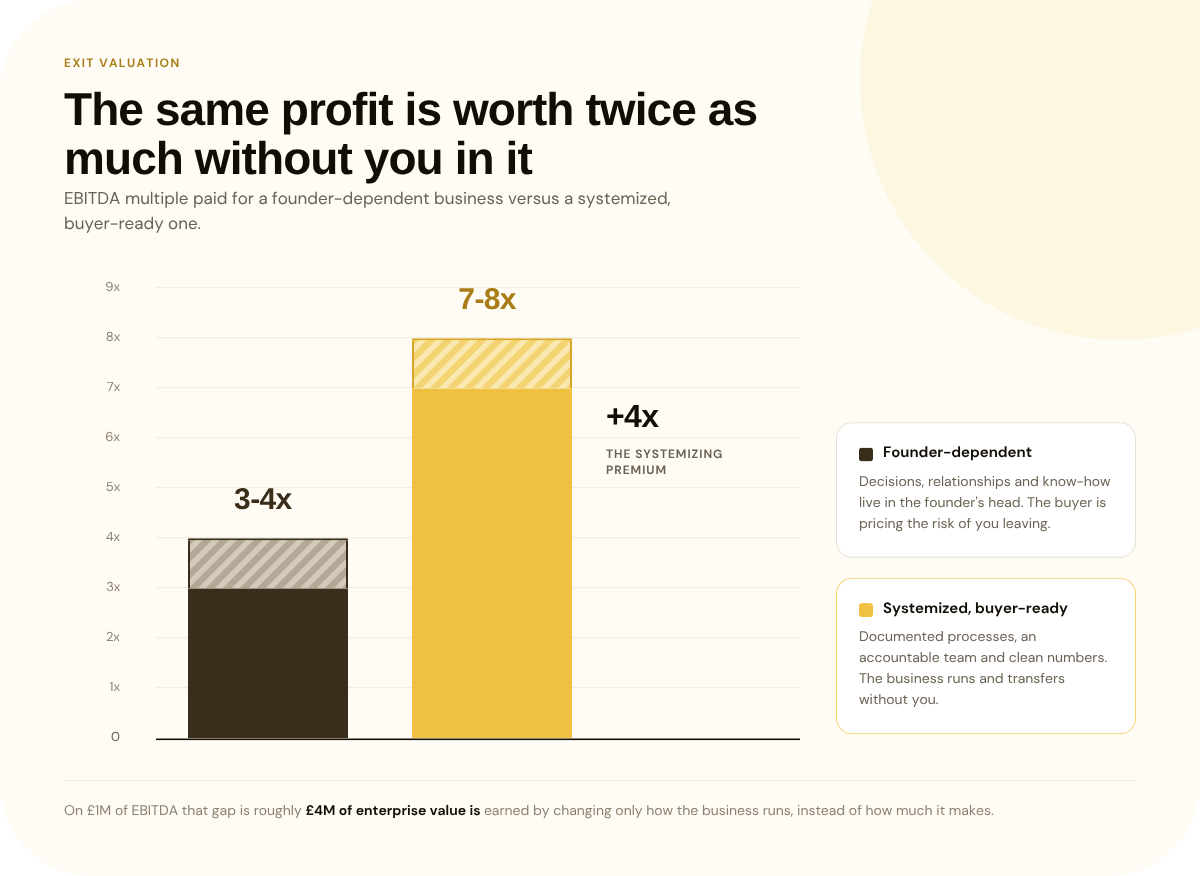
Lower middle market ranges. Source: SE Advisors, "Founder Dependency: The Hidden Valuation Killer".
A founder-dependent business, in other words, doesn't function as a transferable asset. It functions as a job the owner built for themselves, one that happens to have revenue attached. Fixing that isn't about the founder doing less. It's about decoupling what the business can do from whether the founder personally shows up to do it.
Founders who notice the problem usually reach for one of two remedies, and both tend to disappoint. Executive coaching hands over frameworks and accountability, which is genuinely useful for decision-making, but it doesn't leave behind any infrastructure. The founder gets clearer thinking and the same workload.
Rescue hires, typically an experienced operator or COO brought in from a larger company, run into a different wall. Senior operators from established organizations are used to working inside a system that already exists. Dropped into a business where the processes only live in the founder's head, they have nothing to operate. They end up needing the founder to explain the business to them in the same detail the founder was already spending on running it, and the founder ends up back at the center as organizational glue.
This is also why so much AI adoption stalls before it changes anything. Most AI pilots never make it past the pilot stage, and pointing a chatbot at a broken process just automates the chaos faster. The fix that holds is architectural: build the repeatable infrastructure first, and let human headcount and AI agents fill defined roles inside it, rather than trying to manage the gaps with more senior judgment.
The reason this is solvable now, and wasn't five years ago, comes down to three things arriving together. Agentic AI models can now carry out multi-step tasks rather than answer single questions. Workflow orchestration platforms can trigger and sequence those tasks against real business systems. And a standard protocol now exists for connecting the two without custom integration work for every tool.
That last piece is the one most founders haven't heard of yet, and it's the one doing the most work underneath everything that follows.
Historically, connecting an AI system to a CRM, a codebase, and a finance tool meant building a separate custom integration for each pairing, a structure that got harder to maintain every time a new tool was added. The Model Context Protocol (MCP) replaces that with one open standard for how an AI agent discovers and calls the tools available to it. In December 2025, Anthropic donated MCP's governance to the newly formed Agentic AI Foundation, which the Linux Foundation now hosts alongside OpenAI's AGENTS.md and Block's goose, putting the standard on genuinely neutral ground rather than a single vendor's roadmap.
MCP works as a client-server model. An MCP Host, the application orchestrating the work, initiates requests. An MCP Client inside that host manages the session and translates the agent's intent into structured calls. And an MCP Server sits in front of each target system, a CRM, a code repository, a finance platform, exposing what it can read and what actions it can take through a consistent interface. Once a business has MCP servers in front of its core systems, an agent can query live operational data, take an action, and log the result across systems automatically, instead of a founder manually pulling a CRM report and typing the follow-up themselves.
The clearest evidence this works is a small but growing group of founders who have already done it, at different stages of scale and with different degrees of AI reliance.
Happier Leads is the sharpest illustration of both the upside and the limit. George Georgiadis spent five years stuck at $50,000 ARR running a conventional SaaS support stack. He replaced Intercom, HubSpot, and Pipedrive with a self-built system wired to his chat logs, codebase, and session recordings, effectively 24-hour coverage that can diagnose a bug from a support ticket and ship the fix without him. That took the business to $1.5M ARR with no team at all. But Georgiadis's own conclusion is the honest part: a solo operator running an AI engine is still an operator, not an owner, and an operator can't step away or sell. He resumed hiring specifically to convert the AI-run revenue stream into something that could survive without him personally at the console.
Polsia, run by Ben Cera, has pushed the model further, raising $30M at a $250M valuation with zero employees. Its agents handle strategic research, code, ad campaigns, and the founder's own inbox, and Cera has said the system now covers roughly 80% of what would otherwise be founder operations. Chatbase and Peec AI tell a different part of the story: both started as extreme solo or near-solo efficiency plays and then deliberately hired once the AI-run model proved out, because Peec AI's headcount grew from 25 to more than 70 in six months once growth demanded it. The pattern across all four is not "zero humans forever." It's that AI absorbs the coordination work early, which buys the founder room to add people deliberately instead of reactively.
The efficiency gap this produces shows up clearly in revenue per employee. The median for private SaaS companies sits at $129,724 per employee, while Bessemer's research on fully AI-native "Supernova" companies puts their median closer to $1.13M per employee. Midjourney, with a lean team generating around $200M in revenue, runs close to $18M per employee, and Cursor's maker Anysphere scaled from $100M to $1B in annualized revenue in under a year with a team that stayed in the low hundreds throughout. These businesses got there by not needing headcount to grow in the first place.
Every one of those businesses is running some version of the same four-layer stack, whether or not they'd describe it that way.

The orchestration layer is the execution engine, the workflow tool that triggers a process, sequences the steps, and passes data between them. Sitting underneath it, the MCP integration layer exposes the business's systems to whatever agent is doing the work. Those target systems, the CRM, the code repository, the finance platform, hold the operational data and process the transactional updates. And the human-in-the-loop gateway is what keeps the whole thing from running unsupervised into something expensive.
Choosing what sits in the orchestration layer depends on how much of the work is genuinely deterministic versus how much needs open-ended reasoning.
Comparison sources: n8n's production guide, Atlan on CrewAI's limits, and Speakeasy's agent framework comparison.
Most businesses end up running a hybrid: a visual orchestration platform as the system of record for state, credentials, and approvals, which occasionally hands off to a more capable agent framework for a specific step that genuinely needs judgment rather than a fixed script.
The single biggest mistake founders make when automating with AI is assuming a workflow that works once will keep working unattended. It rarely does, and the reason is mathematical rather than a flaw in any particular tool. If a single step in a multi-step agent workflow succeeds 95% of the time, a task chaining twenty such steps together doesn't inherit that 95% reliability. The failures compound: 0.95 raised to the twentieth power works out to roughly 36%, meaning a fully unattended twenty-step process would go wrong on the majority of its runs.
This is why full autonomy is the wrong goal, and why every business in the case studies above still keeps a human checkpoint somewhere in the loop. The pattern that holds up in practice has three parts. Reversible, low-stakes actions, drafting internal notes, logging a CRM update, staging an email, run without a human touching them. Anything irreversible, a payment, a production code change, an outbound message to a client, stops for approval before it fires. And when an agent isn't confident in its own output, it routes the exception to whichever functional owner handles that kind of work, not back to the founder by default. That last point matters as much as the automation itself. A system that quietly reroutes every hard case to the founder hasn't removed the Founder Tax. It's just added a faster inbox.
None of this works as a single project. It's a sequence, and skipping a phase to get to the automation faster is the most reliable way to end up automating a broken process.
The diagnosis phase is the one founders are most tempted to shortcut, and the one where mapping the workflow before automating it pays for itself many times over. A two-week interruption log sounds slow next to the promise of an AI agent fixing everything by Friday, but it's the only reliable way to find out which of the four dependency vectors, decisions, knowledge, relationships, execution, is costing the most. Businesses that skip straight to infrastructure tend to automate whichever process was easiest to describe, not the one generating the Founder Tax.
Realistically, phases one and two take four to eight weeks for a small team working through it alongside normal operations, because it requires the founder to stop and log the interruptions rather than just push through them. Infrastructure deployment in phase three is where timelines vary the most: a business with clean, well-documented systems can wire up MCP connections and a first orchestration workflow in two to four weeks, while one running on spreadsheets and undocumented processes should expect that phase alone to stretch past two months. Phases four and five aren't really endpoints so much as an ongoing shift in how the founder spends their week, and most businesses are still tightening HITL thresholds and adding new automated workflows six months to a year after the first one went live. Anyone promising a fully founder-independent operation in under a month is selling optimism, not architecture.
An architecture like this only stays useful if the AI agents inside it genuinely know how the business operates, which means context has to be engineered, instead of assumed. The pattern that's emerged, borrowed directly from how AI coding agents work, uses a plain-text governance file, commonly named CLAUDE.md or the newer open standard AGENTS.md, placed at the root of a company's internal systems. It states tech stack conventions, decision thresholds, tone, and rules in plain language, so any agent touching that system starts from the same grounding a well-briefed new hire would get on day one.
Underneath that sits a retrieval layer indexing support tickets, sales calls, and internal documentation, so an agent handling a live task can pull relevant precedent rather than guessing. And persistent state tracking, logging what every workflow and sub-agent has already done, is what stops a system restart or a model update from causing duplicate actions or lost context. Get this layer wrong and the rest of the architecture degrades quietly: agents keep running, but their decisions drift further from how the business operates every month nobody updates the context file. Tracking what the system is doing, not just what it was designed to do, is what catches that drift before a client does.
Scaling a business used to mean adding management layers: more managers, more coordination overhead, more meetings whose sole purpose was routing information between people who couldn't talk to systems directly. Decoupling operational capability from the founder's personal presence breaks that link. Revenue growth stops requiring proportional headcount growth, which is the entire reason a Midjourney or a Polsia can put up numbers that would have needed ten times the staff five years ago.
None of this argues for eliminating people. The founders who've done this, Georgiadis chief among them, are clear that the goal was never running solo forever. It was buying the option to hire deliberately, sell the business as a real asset instead of a job, or simply take a real holiday without the business slowing down while they're gone. The Founder Tax was never really about how many hours the founder worked. It was about how much of the business collapsed without them there. Get the architecture right and that's fixed, whatever the founder decides to do next.
Where to start
Before wiring up any AI agent, you need an honest read on where your business is behind. Orbflo's AI Operating System Scorecard scores exactly that.
Take the AI Operating System Scorecard →
No, and the businesses that have done this make that distinction clearly. The goal is decoupling what the business can do from whether the founder personally shows up to do it, not writing the founder out. Georgiadis at Happier Leads went from solo to hiring a team specifically because he wanted the business to be sellable, not because AI stopped working. Reducing founder dependency buys optionality: to step back, to hire deliberately, or to sell at a good valuation. It doesn't require any of those to happen.
Longer than the automation demos suggest. The diagnosis and process design phases typically run four to eight weeks for a small team. Infrastructure deployment varies from two to four weeks for a business with clean systems to several months for one running on spreadsheets and undocumented processes. And the delegated operations and governance phases aren't really a finish line, most businesses are still refining approval thresholds and adding workflows six to twelve months after the first one goes live. Treat any claim of full founder independence inside a month with real suspicion.
Not necessarily, but you do need someone who can configure a workflow orchestration tool and set up MCP connections to your core systems, which is a different skill from writing custom software. Visual orchestration platforms like n8n are built for this, with native MCP support and enough pre-built connectors that most core systems, a CRM, a helpdesk, a code repository, don't require custom integration work. Where businesses tend to need outside help is less the tooling and more the diagnosis: accurately mapping which of the four dependency vectors is costing the most before building anything.





The AI Operating System Scorecard is a diagnostic tool that measures whether your business is structurally built to make AI compound, across nine dimensions including how decisions get made, how clearly your processes are defined and how your team is using and integrating AI.
The output is a clear view of where your biggest leverage gaps are and where to focus first.


One practical AI operating-system insight bi-weekly.
No fluff, no spam.

© 2026 AV Ventures Limited trading as Orbflo | All Rights Reserved