
Insights
/
Business Transformation
/
How to Upskill Your Whole Team on AI Without Spending a Cent in a 12-Week Rollout
Business Transformation

Most companies that decide to "get their team up to speed on AI" go looking for a budget line first: a workshop, a bootcamp, a consultant to run a lunch-and-learn. That instinct is understandable and almost always wrong. The organizations that have built meaningful AI capability in the last two years didn't buy it. They pieced it together from free courses built by the same labs, universities, and open-source projects shipping the tools everyone is trying to learn.
That gap between "we should train the team" and "we bought training" is not a small one. IDC's most recent skills-gap analysis puts the price of unresolved AI shortages at up to $5.5 trillion globally by 2026, driven by delayed projects and missed revenue rather than the cost of any specific course. Meanwhile, demand for self-directed learning has exploded on its own: Coursera's 2026 Job Skills Report recorded generative AI course enrollments climbing 234% year over year, at a pace of roughly 14 new enrollments every minute. People are not waiting for their employer to sort this out.
This piece is a practical, entirely free learning pathway you can hand to a team this week. It is organized by role rather than by topic, because a finance manager and a backend developer do not need the same twelve weeks, and asking them to sit through the same course is how most internal AI training programs fail.
There is a reasonable argument for paying for AI training: a live instructor, a cohort, accountability. None of that is what most struggling companies are missing. Orbflo's own research into why AI pilots stall found that 70 to 95 percent of AI pilots never reach production, and the reason is almost never a lack of tool literacy. It is a lack of the operational scaffolding, governance, and workflow redesign that turns a demo into a working system. Sending twenty people to a paid "Introduction to AI" workshop does not touch that problem, no matter how good the workshop is.
What has changed since that gap became obvious is the supply side. DeepLearning.AI, Hugging Face, Microsoft, and Google now compete to publish the best free introductory material, because the labs behind these models want as many people as possible fluent in using them. The University of Helsinki built Elements of AI specifically to raise a country's baseline AI literacy for free, and it has since been used by learners well beyond Finland. That is the resource pool a training budget would otherwise be trying to replicate at a markup.
The mistake most internal AI initiatives make is treating "AI training" as one thing everyone needs equally. In practice, a team only needs three tiers of depth, and most people only ever need the first one.

Tier 1 is for every employee, regardless of role: enough conceptual grounding and prompting skill to use AI tools well in daily work. Tier 2 is for the people who own a process, an ops lead, a marketing manager, a customer success lead, and want to automate a piece of it without writing code. Tier 3 is for whoever will build and maintain those automations day to day, which in a small company is often one or two people, not the whole team. Pushing everyone toward Tier 3 wastes time; leaving your process owners stuck at Tier 1 wastes the opportunity. This is also why it pays to map your workflows before assigning training, so the tiers line up with real work rather than guesswork.
Nobody needs to write a line of code to get value from this tier. The goal is a common vocabulary and enough hands-on prompting practice that people stop treating AI tools as a novelty and start treating them as part of how work gets done.
Sources: Elements of AI, AI For Everyone (Coursera), AI Prompting for Everyone (DeepLearning.AI). Coursera courses are free to audit; a certificate costs extra unless you apply for Coursera's financial aid.
Fifteen hours or so of this, spread over two or three weeks at a relaxed pace, is enough for most employees to stop asking "should we even be using this" and start asking better questions about how.
This tier is for the people who already know exactly where the busywork lives in their part of the business, an operations manager buried in manual data entry, a support lead re-answering the same five questions. The tool of choice here is n8n, a free, open-source, visual automation platform that lets non-developers wire up workflows, connect APIs, and drop AI steps into a process without writing a backend.
Sources: N8N101, N8N102, N8N103, all part of n8n's free Academy Foundations program, and Build with Andrew.
By the end of N8N103, a process owner with no software background can build a working automation, connect it to a real data source, and hand it a genuinely useful AI step. That is a materially different outcome than "we sent Sarah to a prompting webinar."
Most companies need one or two people at this depth, not the whole team. This tier assumes someone is willing to write a little Python, and it is where the free resources genuinely rival anything a paid program offers.
Sources: AI Python for Beginners, Microsoft's AI Agents for Beginners (nearly 70,000 GitHub stars), Hugging Face Agents Course, AI Agents in LangGraph.
Anyone who wants to go a level deeper on how the underlying models work, rather than just how to build with them, can watch Andrej Karpathy's Deep Dive into LLMs like ChatGPT, a free three-and-a-half-hour walkthrough of tokenization, pretraining, and fine-tuning from a former OpenAI founding member. It is dense, and it is optional, but it closes a lot of "wait, why does it do that" questions that come up once Tier 3 work starts.
The pathway does not need a program manager or a dedicated learning platform. It needs a shared spreadsheet, a protected block of time, and a manager willing to treat it as real work rather than something squeezed in after hours.
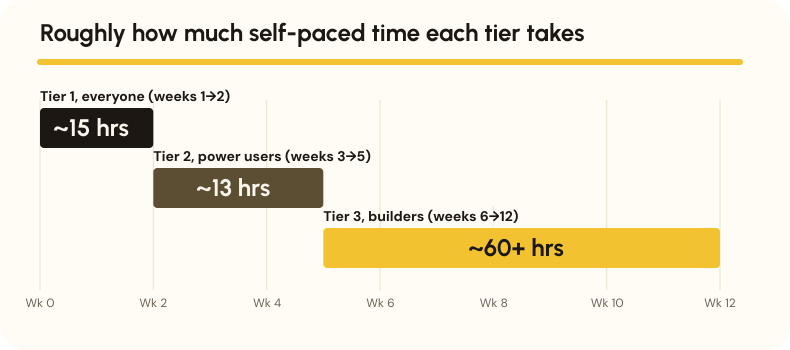
Hours are self-paced totals from each course's own published duration, added up per tier. Tier 3 is deliberately open-ended: it depends how far a given builder wants to go past the core four courses.
Weeks one and two are for everyone, all at once, even the founder. Weeks three through five are for whoever owns a process worth automating, working through the n8n Academy sequence against a real workflow rather than a toy example. Weeks six through twelve belong to the one or two people who will keep building after the pathway ends, and this is the stage where a real capstone matters more than a course: have them automate one thing that currently wastes someone's time every week, end to end, using what they just learned.
A free curriculum can still fail if nobody protects the time to do it. A few things consistently separate the companies where this sticks from the ones where three people finish and everyone else quietly drops off.
Block a fixed weekly slot on the calendar, the same way you would for a standing team meeting, rather than leaving it to "whenever you have a spare hour." Tie Tier 2 and Tier 3 work to one real workflow from day one instead of generic practice exercises, since a person who automates their own recurring task finishes the course; a person working through abstract examples usually doesn't. Run a short weekly show-and-tell where whoever is furthest along demonstrates what they built, not what they studied. And don't gate any of this behind a certificate requirement. Several of these courses offer one, which is a nice bonus, but making completion contingent on a graded assessment adds friction to something that should feel more like giving people permission to spend work hours getting better at their job.
Once a handful of people can build and reason about AI workflows, the constraint usually stops being skill and starts being structure again, whether the business's processes, data, and decision rights are ready to carry more automation. That is a different question from training, and it is worth answering with a audit rather than a hunch. Orbflo's own AI readiness checklist is built for that moment.
For teams that want to go further into managed cloud platforms, Microsoft, AWS, and Google Cloud all offer deeper certification tracks, and they are worth knowing exist. They are also not free: the certification exams themselves typically cost somewhere between one and three hundred dollars each, on top of the study time. Treat that as a deliberate, later investment for a team that has already found workflows worth productionizing, not as the starting point.
Where to start
A trained team is only useful if the business around them can absorb what they build. Before you assign the pathway above, run Orbflo's AI Operating System Scorecard to see exactly where your structure would slow the new skills down.
Take the AI Operating System Scorecard →
No. Tier 1 and Tier 2 are built for people with zero coding experience; n8n was specifically designed as a visual, no-code way to build automations. Only Tier 3 assumes someone is willing to pick up basic Python, and that can be one or two people rather than the whole team.
Four to six hours a week is realistic for Tier 1 and Tier 2 without disrupting someone's actual job. Tier 3 builders tend to move faster with a protected block of a full day or two per week, since context-switching in and out of technical material is expensive.
For the foundational and intermediate tiers, often yes, because the free courses are built directly by the labs and open-source projects behind the tools, not by a training vendor repackaging public information. Where paid options earn their cost is live instruction, accountability, and a curriculum tailored to your specific systems, which is a fair trade if you need it, just not the necessary starting point.





The AI Operating System Scorecard is a diagnostic tool that measures whether your business is structurally built to make AI compound, across nine dimensions including how decisions get made, how clearly your processes are defined and how your team is using and integrating AI.
The output is a clear view of where your biggest leverage gaps are and where to focus first.


One practical AI operating-system insight bi-weekly.
No fluff, no spam.


© 2026 AV Ventures Limited trading as Orbflo | All Rights Reserved