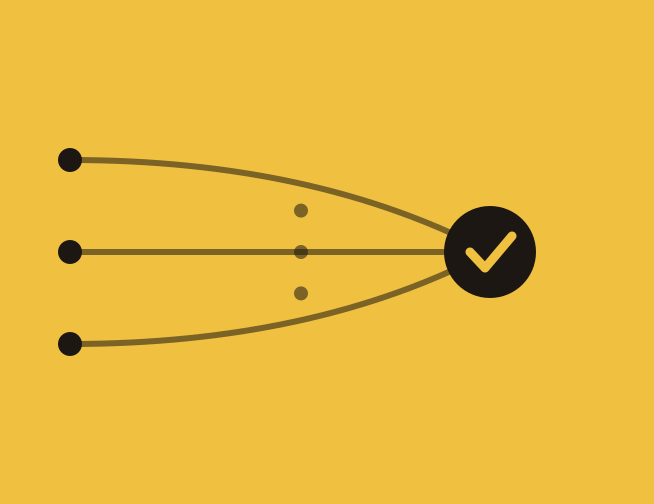
On 25 September 2026 Microsoft relaunched Copilot around Home, Code and Autopilot. The headline features got the coverage. The more important change sat underneath them: a layer Microsoft calls IQ, whose job is to feed Copilot the company's own data, definitions and workflows before it writes a single word.
The example Microsoft used was a salesperson building a proposal. Instead of opening the CRM, the support desk and last quarter's reporting in separate tabs, the salesperson gets deal history and support tickets surfaced inside the work. The model writing the proposal is the same one everyone else can rent. What makes the output useful is what the model was told about this client.
That is the shift worth paying attention to if you run a services firm. When every competitor has access to the same models at falling prices, the advantage moves to whoever has organised what their business knows. Your biggest AI asset is your business context, and right now most of it is scattered.
Microsoft first introduced the IQ layer at Ignite in November 2025 as three connected pieces, each aimed at a different kind of context. The September release pushed them further into everyday work.
Sources for the table: Cloud Wars on the Ignite 2025 launch; Computing on the September 2026 release.
Read the table again and notice what isn't in it. There is no new model. Every row is about getting the right facts, definitions and permissions in front of a model at the moment it needs them. Fabric IQ is the clearest case: a Microsoft vice president said it "brings business meaning to the data in Power BI", which is a polite way of saying the model was guessing what your columns meant until now.
A 3,000-person company on the full Microsoft stack will get a lot of this by default. A 30-person agency running on Google Workspace, HubSpot, a pricing spreadsheet and the founder's memory will get almost none of it. The idea transfers. The plumbing has to be built on purpose.
Two numbers from the 2025 Stanford AI Index explain why. The cost of running a system at GPT-3.5's level dropped more than 280-fold between November 2022 and October 2024. Over roughly the same period, the gap between the best open-weight models and the best closed models on key benchmarks shrank from about 8% to 1.7%.
Cheap, interchangeable models are good news. It also means the model you pick tells a client nothing about the quality of what you deliver. Your competitor down the road has the same one.
The firms getting results have noticed where the difference sits. MIT's NANDA initiative studied why so many enterprise pilots return nothing, and its conclusion was that the core barrier is learning: most systems "do not retain feedback, adapt to context, or improve over time". We covered the wider failure data in why 70 to 95% of AI pilots never scale. The pattern underneath is consistent. A capable model with no knowledge of your clients produces generic work, and generic work is exactly what clients stopped paying a premium for.
The discipline that addresses this now has a name. Anthropic describes context engineering as curating and maintaining the best set of information a model sees while it works, which goes well beyond writing a good prompt. Its guidance points the opposite way from instinct. More context is not better. Anthropic's engineers recommend finding the smallest set of high-signal information that makes the right outcome likely, because models suffer from what they call context rot: recall gets worse as the pile grows.
That finding has been around for a while. Stanford and Berkeley researchers showed in 2023 that models are noticeably worse at using information buried in the middle of a long input than information at the start or end. A bigger context window is a bigger bucket. It doesn't sort what you pour into it.
Ask a founder of a small agency what their AI assets are and you will usually hear a list of subscriptions. Ask what makes their work better than a freelancer with the same tools, and you get a very different list. That second list is the context.
Two things stand out when you lay it out like this. First, the most valuable rows are the least written down. Decision rules and quality standards are what senior people spend their week enforcing by hand, which is a big part of what we called the founder tax.
Second, people already lose a large share of their week to this scatter before any AI is involved. McKinsey found the average knowledge worker spends nearly 20 percent of the working week looking for internal information or tracking down the colleague who has it. An AI agent pointed at the same mess inherits the same problem, only faster and with more confidence.
Most enterprise writing on this topic gets lost in vector databases and graph stores. A small firm needs the concepts, not the vocabulary. There are three kinds of context, and each one fails in a different way when it is missing.
This is the familiar one. The AI looks up relevant passages from your files at the moment it needs them, a technique formalised as retrieval-augmented generation. It is how a tool answers "what did we propose to this client last year?" It works well for policies, past proposals and methodology docs. It works badly for anything that depends on how facts relate to each other, or on what happened after the document was written.
Memory is continuity across sessions: the client said no to option B, the draft is waiting on legal, this account lead prefers short summaries. Without it every conversation starts from zero, which is the learning gap MIT described. With too much of it, and nothing expiring, an agent starts acting on stale facts.
Structure is the definitions and relationships. Which "revenue" figure is the real one, which client belongs to which parent group, which projects use which rate card. This is what Fabric IQ adds to Power BI data. For a small firm it is often the cheapest win: a one-page glossary of your own terms and a clean client list can do more for output quality than a new tool.
Here is the diagnostic Orbflo is building into its products. It replaces the question most AI assessments start with ("which tools are you using?") with six questions asked about one workflow at a time.

The order matters. Teams usually jump straight to access ("let's connect the CRM") and discover three weeks later that the CRM data is incomplete, or that the thing the AI most needed was never in the CRM at all.
Start from the output and work backwards. For a proposal, list every judgment a good senior person makes while writing one, then write down the information behind each judgment. Be specific. "Client history" is too vague. "The last three things this client pushed back on, and why" is usable.
Name the system, the folder or the person. If the honest answer is "Sarah knows", that is a finding, and often the most important one in the exercise.
Can a machine tell what each piece means without a human explaining it? A rate card with clear columns is structured. A pricing spreadsheet with merged cells, colour-coding and a tab called "use this one" is not. Neither is a decision rule that exists only as a pattern in old email threads.
Is it current, complete and agreed? Two versions of the methodology deck, a CRM where half the deals were never closed out, or performance numbers that finance and delivery calculate differently will all produce confident nonsense. Fix the source before you connect it.
Can the AI reach the information at the moment it needs it, through a connector, an API or a standard such as Anthropic's Model Context Protocol? And can it reach only what the person using it is allowed to see? Permissions belong in the plumbing, set by rules, never left to a model's judgment. A junior account manager's AI assistant should not be able to surface partner-level margin data because someone asked nicely.
This is the question most teams skip. Some context should be remembered (a client's standing preferences). Some should expire (a one-off discount agreed for a single project). Some should never be stored at all. If an agent keeps personal data, UK GDPR still applies, including people's right to have it erased. Decide what is kept, for how long and who can delete it before you switch memory on.
Here is how the diagnostic plays out for the same workflow Microsoft used as its example, inside a 30-person marketing agency.
None of the fixes in that right-hand column involve buying anything. They are operational decisions about how the firm records what it knows. That is why we treat context as part of the operating system rather than an IT project.
Firms that take context seriously still trip over a handful of predictable patterns. Most of them come from treating context as volume.
Background on the first pattern: Anthropic on context rot and the "lost in the middle" study. On the fourth: ICO guidance on the right to erasure.
You do not need a data team to do this. You need a few focused weeks and someone senior willing to write down what they currently carry in their head.
Pick two workflows. Choose ones that happen weekly and where quality depends on knowing the client: proposals, monthly reporting, project kick-offs, renewal conversations. If you need help spotting them, process mining shows where work repeats and where it stalls.
Run the six questions on each. One hour per workflow with the person who does it best. Record the answers in a table like the one above.
Fix the cheapest high-value gap first. In our experience it is usually decision rules or pricing logic: write them down as a short, plain document with examples. That single page will improve AI output and make onboarding new staff faster.
Then connect. Once the source is clean and owned, connect it with permissions set. The no-code agency playbook covers the practical wiring for intake, delivery and reporting.
Measure the result per outcome. Track editing time and rework on the two workflows before and after. Cost per outcome is a better test than hours saved, because good context shows up as fewer rewrites, not faster first drafts.
Microsoft is spending heavily to make context the foundation of its AI products for large companies. A small firm can get most of the same benefit with a clean rate card, a written set of decision rules and a habit of recording what clients say. The tools will keep changing every few months. What your business knows, organised so an AI can use it, is the part that compounds.
Take the AI Operating System Scorecard →
It is the work of deciding what information an AI sees while it does a task, and making sure that information is accurate, relevant and permitted. Anthropic frames it as the step beyond prompt engineering: the prompt is one input, but the documents, history, definitions and tool results around it matter as much or more.
No. Microsoft's IQ layer is one implementation of the idea, built for companies already on its stack. Firms on Google Workspace, HubSpot, Notion or a mix of tools can apply the same six questions and connect sources through whichever AI platform they use. Most of the value comes from cleaning and structuring what you know, which is platform-independent.
Larger windows help, but they don't solve the problem. Research shows models use information in the middle of long inputs less reliably, and stuffing in everything raises cost and latency. Choosing the right few documents and keeping them current beats giving the model the whole drive.





The AI Operating System Scorecard is a diagnostic tool that measures whether your business is structurally built to make AI compound, across nine dimensions including how decisions get made, how clearly your processes are defined and how your team is using and integrating AI.
The output is a clear view of where your biggest leverage gaps are and where to focus first.


One practical AI operating-system insight bi-weekly.
No fluff, no spam.

© 2026 AV Ventures Limited trading as Orbflo | All Rights Reserved