Small and medium-sized businesses are buying AI tools at a historic pace. However, most have little to show for it. IBM's 2025 CEO Study, based on a survey of 2,000 CEOs across 33 countries, found that only 25% of AI initiatives have delivered the ROI leadership expected, and just 16% have scaled beyond a single team or pilot. That gap is not a result of weak models or unmotivated staff. It comes from installing a probabilistic technology into an operating model built for deterministic, human-paced work, and expecting the software to fix the seams on its own.
The distinction that gets missed constantly: a business model, an operating model, and a business operating system are three different things, and not working with them is the single biggest reason AI purchases fail to move the P&L. Buying a tool changes none of the three on its own. Redesigning the operating model while building on the business operating system, is what actually lets a business capture the value that was promised in the sales deck.
The business model is the external strategy: who the customer is, what value the company sells, and how it makes money. The operating model is the internal machinery underneath it: how people, process, technology, and decision rights combine to actually deliver on that strategy. The business operating system, things like Gino Wickman's Entrepreneurial Operating System (EOS), is the day-to-day rhythm and administrative cadence, the Accountability Chart, Scorecards, quarterly Rocks, and weekly Level 10 meetings, that keeps the operating model running in practice.
Most SMBs that buy an AI tool are trying to bolt it onto the third layer, the operating system, without ever touching the second, the operating model. A chatbot license doesn't redesign who owns a decision, where a handoff happens, or what triggers escalation. It just makes the existing, unexamined process faster, including the parts of it that were broken to begin with.
The deeper obstacle is what researchers call the Mapping Problem: even with full access to frontier models, most leadership teams don't know exactly where in their own process AI should be inserted. A 2026 Harvard Business School working paper by Hyunjin Kim, Dahyeon Kim, and Rembrand Koning, "Mapping AI into Production: A Field Experiment on Firm Performance," tested this directly with a randomized controlled trial across 515 high-growth startups enrolled in INSEAD's three-month AI Founder Sprint accelerator.
Every firm in the study received identical resources: roughly $25,000 in API credits, frontier model access, and weekly technical workshops from MIT and Harvard instructors. The only variable that changed was the strategic framing of those workshops. The control group learned standard lean-startup methodology applied to AI tools. The treatment group was shown detailed "before AI" and "after AI" process maps from other companies, illustrating how entire chains of human tasks could be compressed, reordered, or eliminated rather than just accelerated.
The treatment group didn't get better tools. They got a better map of where to point the same tools, and the results were outstanding.
Design tool Gamma had its product managers stop handing specs to designers to engineers to QA in sequence, and instead used AI to generate product variations directly from usage logs, with the PM's role shifting to building evaluation checks that monitor generation quality rather than writing specs by hand.
Ryz Labs replaced a single prototype built over months with several AI agents generating competing tech stacks live on customer calls, collapsing a validation cycle that used to take a quarter into something closer to real time.
Finance automation firm FazeShift eliminated the human "glue" work of manually reconciling QuickBooks against bank portals, building a fully autonomous accounts-receivable pipeline that only routes genuine anomalies to a person instead of touching every transaction.
QA firm Ranger converted a linear, billable-hours testing service into a productized model built on agentic test coverage, trading labor costs for software margins and reducing its own dependency on outside capital in the process.
A quieter, second-order effect showed up across all four: once a workflow is redesigned so that AI sits directly inside the production process rather than beside it, every human edit, approval, or rejection of an agent's output becomes a labeled data point. Over months, that accumulates into a proprietary record of exactly where the model gets it wrong in this specific business, a "rejection library" that a competitor can't replicate just by licensing the same public model. The redesign produces so much more than a faster process. It produces a compounding, defensible asset that a bolted-on chatbot license never will.
The inverse pattern shows up just as clearly in companies that bought the tool first and only redesigned the process after it stopped delivering.
Zillow is the case worth sitting with, because it's the cleanest illustration of what "no operating model redesign" actually costs. The Zestimate model itself wasn't the problem. The failure was an operating model that fed a probabilistic pricing engine only clean quantitative data, with no structured loop to reconcile the messy, qualitative reality of an actual house, and no human checkpoint sized to the risk of buying property at scale. When the market shifted, there was no operational mechanism built to catch it.
Layering AI onto an unchanged operating model tends to produce the same five failure patterns, regardless of industry.
To find these cracks before they calcify, leadership needs honest answers to five questions:
Most SMBs can't answer more than one or two of these for any given AI tool they've deployed.
This is where the gap bites hardest for lean, founder-led businesses specifically. A large enterprise can absorb the rework burden and the human-in-the-loop overload with a dedicated ops team; a twenty-person agency or a founder consultancy usually routes both straight back to the founder, because there's no one else the exception queue can go to. That's the quiet mechanism behind leadership dependency: nobody redesigned the workflow to let anything but leadership absorb the ambiguity an AI tool couldn't resolve on its own.
The instinctive response to probabilistic risk is to add a human checkpoint at every step. That instinct is exactly backwards. Inserting manual approval after every AI action, draft, review, optimize, review, format, review, publish, just rebuilds the old manual workflow with extra software cost layered on top. The organization gets marginal quality control and none of the scaling benefit it paid for.
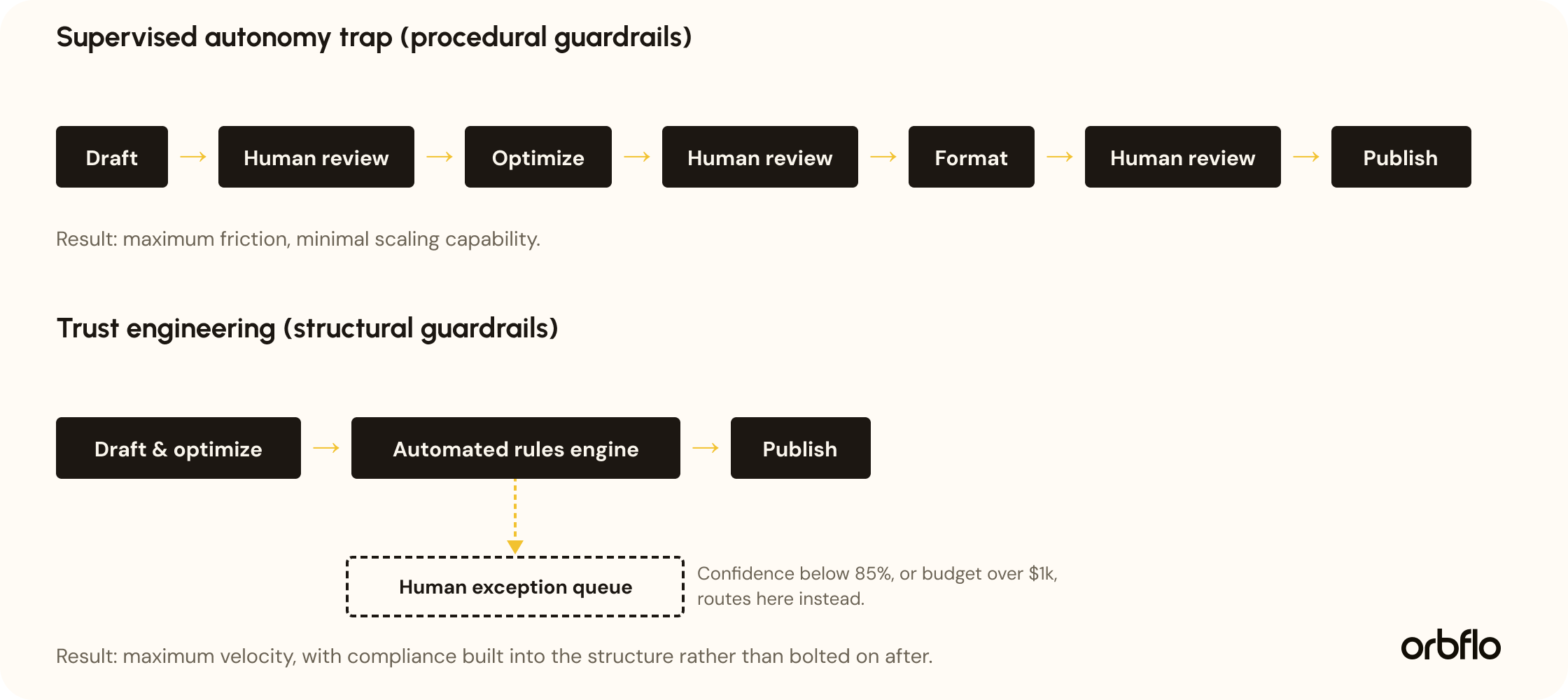
Trust Engineering rests on three technical foundations. First, permission-aware agents: an AI agent acting on someone's behalf is programmatically blocked from any data that person isn't authorized to see, enforced at runtime rather than checked after the fact. Second, confidence scoring: every machine-generated output carries a confidence level, and only low-confidence or high-risk cases route to a human, reserving people for genuine edge cases instead of routine approvals. Third, unified audit trails: every prompt, retrieval, output, and human edit gets logged automatically, which in regulated industries can produce an audit trail more thorough than the manual process it replaced, while cutting review cycles dramatically.
Most companies invert this ratio without realizing it. Boston Consulting Group's research puts only 10% of transformation value in the algorithm itself, 20% in the surrounding technology and data infrastructure, and 70% in people, process, and workforce change, yet most SMBs spend the overwhelming share of their budget and attention on the first two layers.
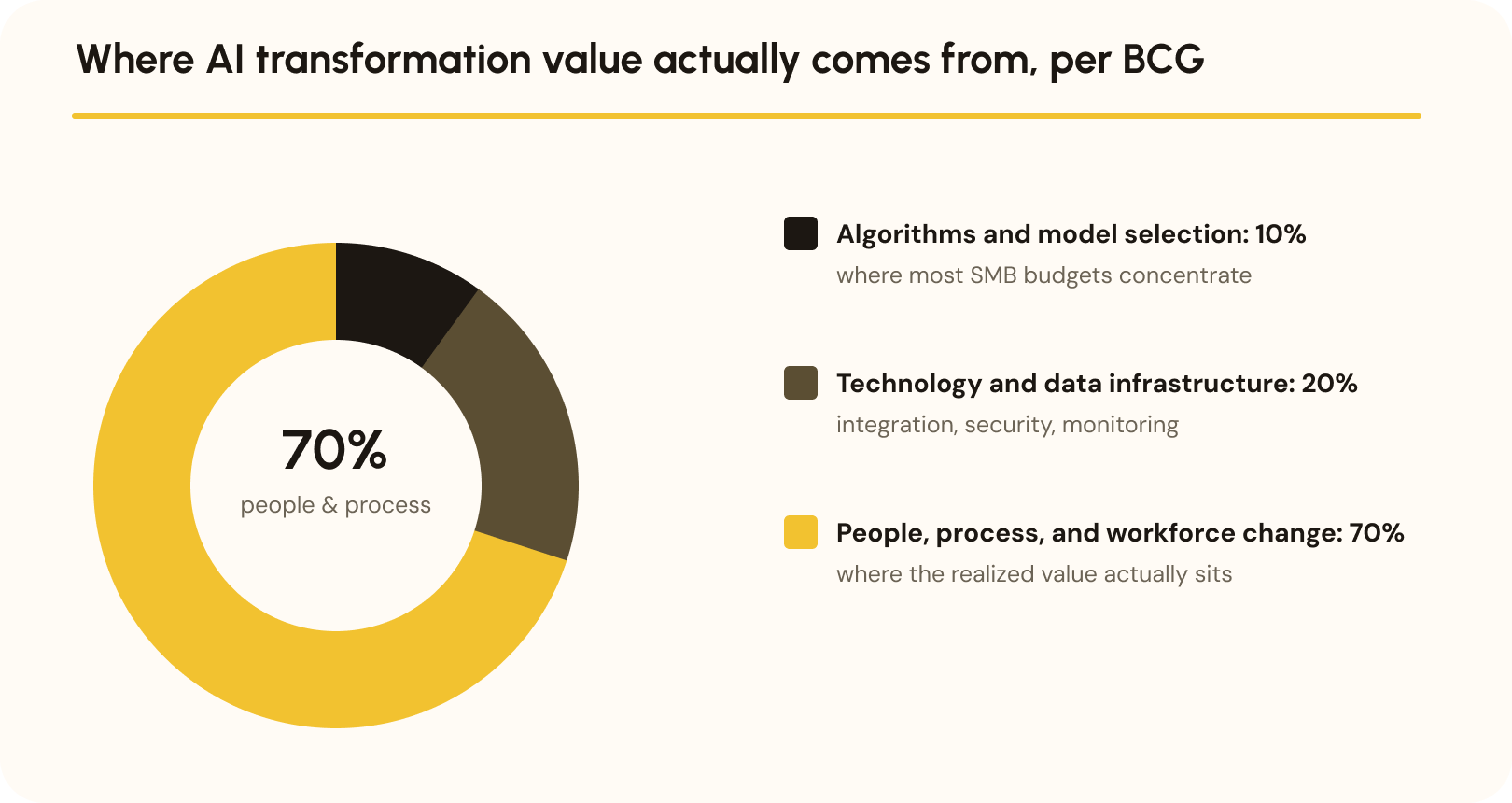
The return on the 70% layer compounds. In BCG's work upskilling a financial services group on generative AI, 98% of participants went on to generate new use case ideas of their own, 80% applied what they learned directly to live projects, and 85% reported using AI more often at work afterward. None of that came from a better model. It came from teaching people what to point the model at.
The efficiency case is real even at the lower end. A UK government trial of Microsoft 365 Copilot across more than 20,000 civil servants found an average of 26 minutes saved per person per day, nearly two working weeks a year, on drafting and summarizing alone, without any workflow redesign at all. That's the baseline case for doing nothing structural. Businesses that go further and redesign the surrounding process around the tool, rather than just accelerating the existing one, see a different order of magnitude: content localization workflows that traditionally run $0.15 to $0.30 per word in human translation cost have dropped well below $0.10 per word once AI drafting is paired with translation memory and a redesigned review step, rather than simply having a person translate faster.
None of this requires an enterprise transformation program. It requires five steps done in order, before any new AI contract gets signed.

Step 1: Audit the top five workflows. Map every human step, decision point, and handoff, and track actual cycle time, rework rate, and cost. Anywhere a person is manually moving data between two systems is the highest-leverage target for automation.
Step 2: Clean and standardize the data underneath it. AI can't reason across systems with contradictory data definitions. Build a short data dictionary: what each field means, where it comes from, who owns it.
Step 3: Redesign the Accountability Chart. Put every AI agent directly on the org chart, reporting to a named human seat. That person should pass the EOS GWC test, get it, want it, and have the capacity to manage it, and stays accountable for the agent's business outcomes, not just its uptime.
Step 4: Write a lightweight SOP for every agent. Define what triggers it, exactly what data and tools it can touch, the confidence threshold that separates autonomous execution from mandatory human review, and the specific escalation path when it hits an anomaly. Scale autonomy gradually, weeks at draft-only, then human-approved action, before any agent earns narrow autonomy.
Step 5: Budget for ongoing tuning. An operating model isn't a one-time install. Set aside 20% to 30% of the initial AI budget annually for monitoring, retraining, and adjustment, and put error rates and exception volumes on the same weekly scorecard as every other metric that matters.
The operating model is the internal architecture, how people, process, technology, and decision rights combine to deliver on strategy. The business operating system, like EOS, is the day-to-day administrative rhythm, meetings, scorecards, and accountability structures, that keeps that architecture running. AI tools fail most often because they're added to the operating system layer without ever redesigning the operating model underneath it..
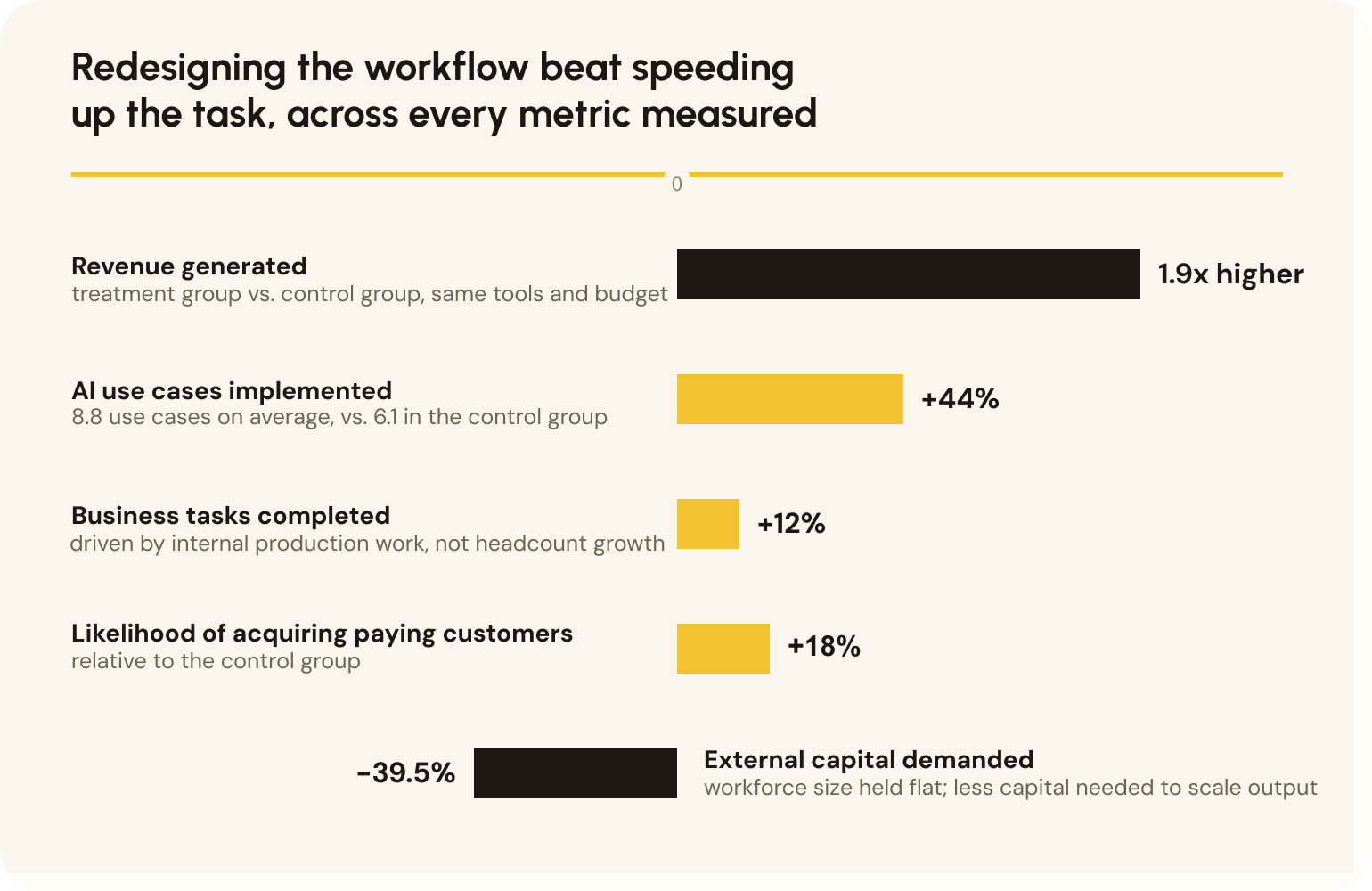
A 515-startup field experiment found that firms which redesigned entire workflows around AI, rather than using it to accelerate individual tasks, generated 1.9x more revenue and implemented 44% more AI use cases than firms using identical tools and budgets without redesigning the process. The tools were the same but where and how they were applied was completly redesigned.
Trust Engineering embeds compliance and risk boundaries directly into the software architecture, permission-aware data access, automated confidence scoring, and audit trails, rather than adding manual human sign-off at every stage. Adding more review steps (the Supervised Autonomy Trap) increases cost and friction without meaningfully improving safety. Structural guardrails route only genuine high-risk or low-confidence cases to a human, so the business gets both scale and compliance.





The AI Operating System Scorecard is a diagnostic tool that measures whether your business is structurally built to make AI compound, across nine dimensions including how decisions get made, how clearly your processes are defined and how your team is using and integrating AI.
The output is a clear view of where your biggest leverage gaps are and where to focus first.


One practical AI operating-system insight bi-weekly.
No fluff, no spam.

© 2026 AV Ventures Limited trading as Orbflo | All Rights Reserved